| | | THE MYTH OF “STYROFOAM CUPS” | | This article explores the issue of whether styrene from foam cups and containers can leach into food. But first, let's clear up something: Styrofoam cups cannot possibly be a problem in this regard—Styrofoam cups do not exist! "How can that be?" you say, "I just drank from one this morning!" Nope. You most likely drank from a polystyrene cup. Styrofoam is a trademarked material made by the Dow Chemical Company—and they don't make cups, plates, egg trays, or other types of food packaging from it! To quote them directly: "Next time you get a cup of java to go, remember, you can't drink coffee from a STYROFOAM cup—because there is no such thing!" | | | All day long in our fast-paced modern world, coffee gets poured into foam cups. Double-decker mega-burgers get plopped into foam clamshells. Restaurant leftovers get put into "doggie bags"—usually foam food containers. Most foam cups and containers are made out of polystyrene, and therein lies the rubber biscuit. The basic chemical component of the material (styrene) has the potential to leach into your food and then into you. This article discusses the probability of this happening and the potential health effects. | It was big news years ago when McDonalds moved some of its sandwiches out of their trademark foam clamshells and into paper wrappers. The environment was proclaimed the winner and we all went back to saying, "Yes, I'll have fries with that." But foam food containers—or more properly, polystyrene food containers—did not go away. Today they are still going strong in both food and non-food applications. The table below provides examples. | | | | | - coffee cups
- soup bowls and salad boxes
- foam egg cartons; produce & meat trays
- disposable utensils
| - packing "peanuts"
- foam inserts that cushion new appliances and electronics
- television and computer cabinets
- compact disc "jewel boxes" and audiocassette cases
| | Polystyrene clearly has many non-food uses, but this article will focus on the implications of using polystyrene in food and beverage applications. Most importantly, we will talk about how styrene—the "monomer" form of polystyrene—can migrate into your food and beverages from polystyrene food containers. The migration of styrene from a polystyrene cup into the beverage it contains has been observed to be as high as 0.025% for a single use. That may seem like a rather low number, until you work it this 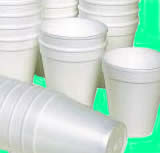 way: If you drink beverages from polystyrene cups four times a day for three years, you may have consumed about one foam cup's worth of styrene along with your beverages. Mmm.... chem-i-callyyyy... way: If you drink beverages from polystyrene cups four times a day for three years, you may have consumed about one foam cup's worth of styrene along with your beverages. Mmm.... chem-i-callyyyy... Styrene migration has been shown to be partially dependent on the fat content of the food in the polystyrene cups/containers—the higher the fat content, the higher the migration into the food. Entrees, soups, or beverages that are higher in fat (like a bowl of three-cheese chili or tall cupful of Triple-Cream Frappa-Mocha Java Delight) will suck more of the styrene out of the polystyrene container than, say, water. Some compounds found in beverages, like alcohol or the acids in "tea with lemon," may also raise the styrene migration rate. When it comes to more solid food, the meat or cheese you buy from the market on a clear-plastic-wrapped polystyrene tray may be picking up styrene from the foam container. Styrene also appears to migrate more quickly when foods or drinks are hot. Studies suggest that styrene mimics estrogen in the body and can therefore disrupt normal hormone functions, possibly contributing to thyroid problems, menstrual irregularities, and other hormone-related problems, as well as breast cancer and prostate cancer. The estrogenicity of styrene is thought to be comparable to that of Bisphenol A, another potent estrogen mimic from the world of plastics. Long-term exposure to small quantities of styrene is also suspected of causing: - low platelet counts or hemoglobin values;
- chromosomal and lymphatic abnormalities;
- neurotoxic effects due to accumulation of styrene in the tissues of the brain, spinal cord, and peripheral nerves, resulting in fatigue, nervousness, difficulty sleeping, and other acute or chronic health problems associated with the nervous system.
The International Agency for Research on Cancer lists styrene as a possible human carcinogen, though this conclusion is primarily based on studies of workers in styrene-related chemical plants. The Vallombrosa Consensus Statement on Environmental Contaminants and Human Fertility Compromise includes styrene on its list of contaminants of possible concern, noting that even weak estrogen mimics can combine with other such chemicals to have negative effects even when the chemicals are individually present at levels that would have no impact. On the positive side, a 2005 expert panel convened by the National Institutes of Health concluded that there is negligible concern for developmental toxicity in embryos and babies. | Overall, the evidence of health impacts from polystyrene, styrene, and foam food packaging is suspicious though not clearly damning. More studies are needed. But we know from studies of other chemicals that long-term, constant exposure to small amounts of foreign substances—especially those that mimic hormones—causes problems. Further, styrene is a benzene-based molecule, and the evidence against benzene is pretty clear, so we personally avoid polystyrene (and all plastic) when it comes to consuming or storing food. | | A CERAMIC MUGGING | | Always using a ceramic mug instead of a foam cup is highly advisable, and mugs with lead-free components are preferable. If you use a "regular" mug, watch for breaks in the inner ceramic surface that might expose your beverage to the lead. If chips or scratches show up, pitch the mug. | | Our recommendations are: - Use ceramic plates, bowls, and mugs/cups whenever possible. If you can't do that, choose paper over polystyrene.
- Item 1 applies especially if your food or beverage has medium to high fat content; contains alcohol or acidic substances; or is hot. On this last point, never microwave or heat food in polystyrene containers.
- If a supermarket item came in polystyrene packaging, consider transferring it to a non-plastic container until you're ready to cook or eat it. Glass, ceramic, or porcelain containers, bowls or plates are preferable for food storage (so you don't get chemicals from plastic food containers). If you can choose food products that don't come in polystyrene containers in the first place, so much the better. (And remember that most restaurant "doggie bags" are really polystyrene food containers.)
- Buy food in glass containers when possible. For non-glass-packaged items, buy the larger sizes, where the surface contact between the contents to the container is reduced. (Buying in large sizes makes economic sense anyway, assuming you can use it all.)
People occasionally have sent us questions and comments about foam coffee cups, foam food containers, and related issues. Here are a few of their questions ... and our answers. Q. I read somewhere that a US EPA study found styrene in 100% of fat samples biopsied from human subjects. Is that true? A. Yes, it's true. The study results were presented as part of the agency's document, "The Broad Scan Analysis: Human Adipose Tissue Survey." The study has been criticized by some for its choice of methodology, but that is not to say that its results are necessarily invalid. Unfortunately, like so many other scientific documents, it seems to have disappeared from the EPA's web site, so you can't go look for yourself. Q. I was recently on a flight [and] I was quite upset that they still serve hot drinks in Styrofoam cups [sic]. How do we get words out there for a change to a safer choice [like] cardboard? A. First, as we've mentioned before, Styrofoam is not used to make food containers. That said, here is our answer. There are worse environmental and health threats out there than polystyrene, but since alternatives exist and it's easy to make the switch, why not do it? Some people will listen when you tell them things like "drinking out of a foam cup is not your best choice." Others just think you're a nut or a hypochondriac and ignore you. The first group is why we started Grinning Planet -- to try to inform people. As for the latter group, it usually takes some personal health disaster before they wake up and start paying attention. Environmental and public interest groups can also have some effect by organizing boycotts and letter-writing campaigns, and by working directly with companies to try to get them to change their policies, supply sources, and products. Supporting these efforts is a good thing. Q. On my way to work today, I decided to stop by a local Mexican restaurant drive-through and order a taco plate. It came in a [foam] container, which is still the normal serving container for smaller restaurants. I took the food to my desk and squeezed some lemon juice on my tacos from the freshly cut lemon wedges that were served with the meal. I then placed the lemon wedges in the top portion of the container. When I was finished eating, about 10 minutes later, I moved the wedges to throw them away and noticed holes the in container where the wedges laid. Imagine my surprise at the realization that something natural (lemon juice) could breakdown something manmade. Could lemon juice be the solution to get rid of the [large amounts of foam trash] in our landfills? A. Another of our readers suggests an answer for this question:
Citric acid in the rind will "pop" the beads [that together form the polystyrene material], letting air escape. Sounds plausible to us. The reason the beads pop would be that the structural integrity of some of the polystyrene beads has been damaged by the citric acid. Once polystyrene is converted to styrene, natural processes can break it down the rest of the way fairly readily, so this sort of reaction could be helpful in catalyzing the overall degradation of polystyrene. But we suspect that to take on mountains of polystyrene trash with lemon juice would not be so simple, since the foam trash is crammed together with all the other trash. The lemon juice (and the microbes than break down styrene) are unlikely to work effectively in such an environment. Q. Are there any studies that you are familiar with that compare environmental impact of [foam] plates and cups with biodegradable paper compared to china? Comparisons of energy required to produce products, as well as impact to dispose of products would be helpful. Also energy required to wash china and impact of detergents so that there is a net impact both to the environment and the health of humans and or animals connected to the use of the various products. A. There may be studies, and your question is reasonable, but it's beyond the scope of this article. That said, here are some general thoughts. In our opinion, it's preferable to use washable dishware. The cost of the "real" cups, plates, and utensils plus the water use and energy use are part of the equation, but the pollution factor associated with polystyrene has to be given a lot of weight. "Plastic pollution" is becoming a very, very big problem in the environment generally and in the ocean specifically. Reducing the amount of polystyrene trash in the environment is a good thing, period. The monetary cost-benefit case will be harder to make since many of the costs of product manufacturing, use, and disposal are externalized as unbilled environmental degradation and human health impacts. I suspect that polystyrene food containers are going to easily beat the cost to procure and manage a set of real dishes. But in our opinion, any company that wants to take a step forward in protecting the environment and the health of its employees can do so by making the switch from polystyrene food containers to real dishes (or at least to foam containers made from natural materials). Q. Styrene is a naturally occurring product that is in many of the foods we eat. Do you think that, just perhaps, some of that styrene found in one's body may have come from actual food? A. Migration from foam food containers into food is not the only way we can get an unwanted intake of styrene. Other sources include: - dental fillings
- agricultural products
- food additives
- breathed-in fumes from some protective coatings, glues and adhesives
- polluted air or cigarette smoke
On the food front, a 2005 NIH Monograph on the Potential Human Reproductive and Developmental Effects of Styrene (opens as PDF, 6 MB) lists some "natural styrene content" values for selected foods: | | | | | Cinnamon | 170 - 39,000 | | | | Beef | 5.3 - 6.4 | | | | Black currants | 2 - 6 | | | | Coffee beans | 1.6 - 6.4 | | | | Peanuts | 1 - 2.2 | | | | Strawberries | 0.37 - 3.1 | | | | Wheat | 0.4 - 2 | | The report did not give an explanation for cinnamon's outlying value. The same report also looked at styrene values in packaged food, which in general were higher than in the natural foods. Here are a few: | | | | | Milk and cream | 134 (avg) | | | | Beer | 32 | | | | Yogurt | 26 | | | | Desserts | 22 | | | | Soft cheese | 16 | | The amount of styrene in the food was found to be directly proportional to the fat content of the food and inversely proportional to the size of the container. The latter point makes sense, since larger containers would expose a lower percentage of the food to the container. What does all this mean? Mostly it means you'll have a pretty hard time avoiding styrene altogether. To us, though, it does not mean that we're just going to shrug and not worry about it. Instead, we choose to be sensible—to avoid plastic and foam packaging when we can and eat whole, non-processed foods as much as possible. The latter point is a good idea regardless of the evidence on styrene migration or how serious a health threat it might or might not be. | Know someone who might find this article about foam cups and food containers interesting? Please forward it to them. Books: - See books related to household chemicals/toxics
Search Amazon.com for ....
| | | GP ARTICLES RELATED TO
Foam Cups/Food Containers
| | | | “LEFTOVERS AGAIN?” SAID THE REFRIGERATOR Plastic Food Containers, Health, and Better Food Storage Solutions KILLER POTATO CHIPS OF DEATH FROM THE DARK SIDE OF DOOM Acrylamide in Food — A Health Risk Worth Worrying About? “ENGAGE THE GLOBAL TOXIFICATION WEAPON!” SCREAMED THE KLINGON COMMANDER Hormone Disruptors — The New-Found Problem with Chemicals | | | | More articles and resources on.... You can sign up for our free email list so you don't miss anything! Options: |